Showing posts with label spelt bread. Show all posts

Monday, January 21, 2013

mongrel spelt, mega stout & a video

ok, so, this post is about: a 25 hour(!) final fermentation, increased hydration in relation to achieving ridiculous ears, and scoring. lots of people have been emailing me about how to score the spiral -  remember in my last post, i declared that one must hold the razor blade horizontal to the loaf, and i always score deeply, going over the slash twice with the razor blade. well, i decided to try my hand  at making a video of my spiral scoring... of course, you all know how i love superfluity, so i ended up making two...


some of you have sent in pictures of your spirals, hooray! i've made a scrapbook of them below. thank you for sharing, it always makes my day.

so, my guinea pigs for this enhanced hydration/extended final ferment were a stout dough using all stout, no water. i realize that i'm flogging a stout horse here, given my last stout bread, but i wanted to share what a full stout loaf was like, in case you wanted to dump a whole can of guinness in your next bread. and a dough using a mongrel assortment of spelt flours - 167g white spelt, 83g light spelt and 250g KA bread flour - because i had a few grams of this and a few grams of that...


i firmly believe that whilst pleasurable, sure, baking must also be a thrifty pursuit. you can shell out some serious dough for flour, and i don't know about you, but i bake bread because it's economical. i can't afford to spend six or seven bucks for a loaf of bread from a great bakery. just so you can see how cheap it is to make your own bread, i did some math and calculated that a loaf of my 'city bread, in rye' (which i make most often here), which uses 90g BRM organic rye flour and 410g of KA bread flour comes out to $1.40 a loaf! and the loaves that we make at home are MUCH larger than the loaves that you buy from a bakery.

so, if you have a little of this and a little of that, why not make a mongrel bread rather than letting the flour go stale?


mongrel bread, in spelt

increased hydration does not allow for the same intense ears of my other loaves, as you can see. just a comparison, the hydration in the stout bread is 80.3% and the mongrel bread is about 77.8%; and my breads usually weigh in at about 72% hydration. so, the small increase in hydration does affect your scoring. but, i'm not complaining.


mega stout

the thing that i noticed about using beer in place of water is that it seems to tighten the dough. it makes sense, since beer is obviously more viscous than water, so i think that your breads will call for a higher hydration in view of this. i must say, the last demi-stout that i experimented with was pretty awesome, but if you're going to make a beer bread, you may as well make one that tastes fully of beer, unless you are using a very bitter IPA and want to temper its bite. i would say, after this experiment, that you can safely replace all of the water with beer in your bread, especially if you are using sweeter brews. have a look at my friend bernd's beer post over at bernd's bakery. if you don't already know his blog, you definitely should. he makes some of the finest loaves on the net with instructions in english and german to boot!

without further delay, here is your mongrel spelt, your mega stout, and your superfluous videos.

MEGA STOUT


mega stout with toasted hazelnuts

THE NIGHT BEFORE THE DOUGH

Make your levain:

50g 100% rye, 100% hydration starter
100g BRM dark rye
100g cold stout

mix the above and let ferment. mine fermented for 8 hours.

DOUGH DAY

250g levain
377g stout, i used 'boatswain' chocolate stout, you might try guinness or another brand
90g BRM dark rye flour
410g KA organic bread flour
12g kosher salt
150g toasted hazelnuts

mix all of the ingredients above MINUS the salt and the hazelnuts, until you reach a shaggy mass. autolyse for one hour.

after the autolyse, add the 12g of salt. squish the salt and water into the dough until fully amalgamated. now fold in the hazelnuts.

over the next 4 hours, your bulk fermentation takes place. for the first two hours of the bulk fermentation, perform a series of turns every half hour for a total of four series of turns. refrigerate the dough for the last two hours, unmolested.

after the bulk ferment, turn the dough out onto a workspace that has been dusted with organic brown rice flour. i use BRM. rest the dough for 15 minutes, then flip it over onto a CLEAN part of the workspace and form into a boule (the clean workspace creates friction under the dough, helping to make a nice, tight boule).

pop the dough into a linen-lined bowl that has been dusted with brown rice flour. cover, and refrigerate for 25 hours...


MONGREL SPELT


mongrel spelt


THE NIGHT BEFORE THE DOUGH

Make your levain:

50g 100% rye, 100% hydration starter
100g BRM dark rye
100g cold filtered h2o

mix the above and let ferment. mine fermented for 8 hours.

DOUGH DAY

250g levain
360g cold filtered h20
167g vitaspelt organic white spelt flour
83g BRM light spelt flour
250g KA organic bread flour
12g kosher salt

mix all of the ingredients above MINUS the salt until you reach a shaggy mass. autolyse for one hour.

after the autolyse, add the 12g of salt. squish the salt and water into the dough until fully amalgamated.

over the next 4 hours, your bulk fermentation takes place. for the first two hours of the bulk fermentation, perform a series of turns every half hour for a total of four series of turns. refrigerate the dough for the last two hours, unmolested.

after the bulk ferment, turn the dough out onto a workspace that has been dusted with organic brown rice flour. i use BRM. rest the dough for 15 minutes, then flip it over onto a CLEAN part of the workspace and form into a boule (the clean workspace creates friction under the dough, helping to make a nice, tight boule).

pop the dough into a linen-lined bowl that has been dusted with brown rice flour. cover, and refrigerate for 25 hours...

BAKE DAY

one hour before you plan to bake, preheat the oven to 550 degrees outfitted with both halves of 2 cast iron combo cookers and a baking stone.

after the FULL hour of preheating, pull the dough out of the fridge, fit a piece of parchment over the mouth of it, place a peel on top, and flip the bowl over so that the dough lands on the parchment over the peel. score the dough in some unique fashion, making sure to go over it twice with the razor, and deeply to boot. check out the video on how i make the spiral:

TAKE ONE...

TAKE TWO...


slide the dough, parchment and all, into the shallow end of your awaiting combo cookers. cover with the fat end. turn the oven down to 475 degrees and steam for 30 minutes.


after the 30 minute steam, remove the fat end of the combo cooker wearing an oven mitt to avoid a nasty steam burn. marvel at your perfectly steamed loaf. slide it back into the oven, turn it down to 450 degrees and bake till chestnut brown.


Wait a full hour and a half before slicing.

the verdict: OMG. the mongrel spelt was incredible. excellent crumb structure, uber shattery crust. the mega stout was smoky with an open, tender crumb and an amazingly shattery crust as well.

a big THANK YOU to everyone who sent in pictures and those who continue to send me emails letting me know how their bread is turning out. i am sooooo happy to share all of this with you!

THE SUPERFLUOUS SHOTS


TARTINE XP FRIENDS

and now for our bread friend's loaves...

SAM IN THE BAY AREA
sam just did a mind-boggling spiral in the bay area. GO SAM!


FINNISH RIIIKA
riikka just got some ridiculous ears in finland. YEAH RIKKA!


KRISTEN AT 'DECORATE THIS'
kristen at 'decorate this' just sent me these lovely pictures. she used the stout formula to make a cider bread, and a stout bread of her own. check out those ears and the fantastic swirl!


This post has been sent off to Susan's Wild Yeast Blog.

to the staff of life!

Monday, December 10, 2012

the classic

so, tell me what you think of this. bacon. gruyere. leeks. in a bread. holy cow, right? because if you put this combination on/into anything, it's bound to be good. i'd been wanting to do this bread for a while now, but before i get into the specifics of the thing, i have to talk about a few emails that i've received lately about starters.

the classic, in spelt

it's a daunting thing starting a new sourdough starter. i know firsthand because, well, my own challenge is what compelled me to start this whole experiment to begin with. my own starter has indeed evolved over time. it began as a 100% hydration 50/50 whole wheat/all purpose starter and ended up a 90.5% hydration 100% organic dark rye starter (you can use your 100% hydration starter for your all of the formulae on my blog).

my starter is 60g total: 20g of starter, 19g of h2o, 21g of dark rye (either bob's red mill or to your health sprouted rye). i like my starter a tad on the stiff side, and the extra couple of grams of flour gets it right around where i like it.


recently, one of my readers sent me pictures of his starter. he was fretting over the density of it (his was right at 100%, and he was convinced that it would not ferment properly). he figured that it needed more water. here's the thing, there are stiff starters (75% hydration), more liquid starters (my friend Joe uses a 125% hydration starter), our (more or less) 100% hydration starter and all hydrations in between. it's really up to you to decide what strikes your fancy what sort of starter you want to use, and whatever the case, you can 1) adapt the formula you are following to work with whatever hydration your starter happens to be 2) easily change the hydration of your starter if you want to adjust the starter to the formula instead by doing a little planning. just begin feeding it more or less water/flour to arrive at the called for hydration a couple of days prior to bake, and you are good to go. a stiff starter WILL ferment, if you don't believe it, i have photographed the progression of my rather stiff starter starting before feeding and the hours ensuing:


just before feeding

the above photo is my starter first thing in the morning, just before feeding. the bottom two pictures are photos taken moments after feeding. i have included top and side shots for you. as you can see, it is rather stiff.

just after feeding, top and side views

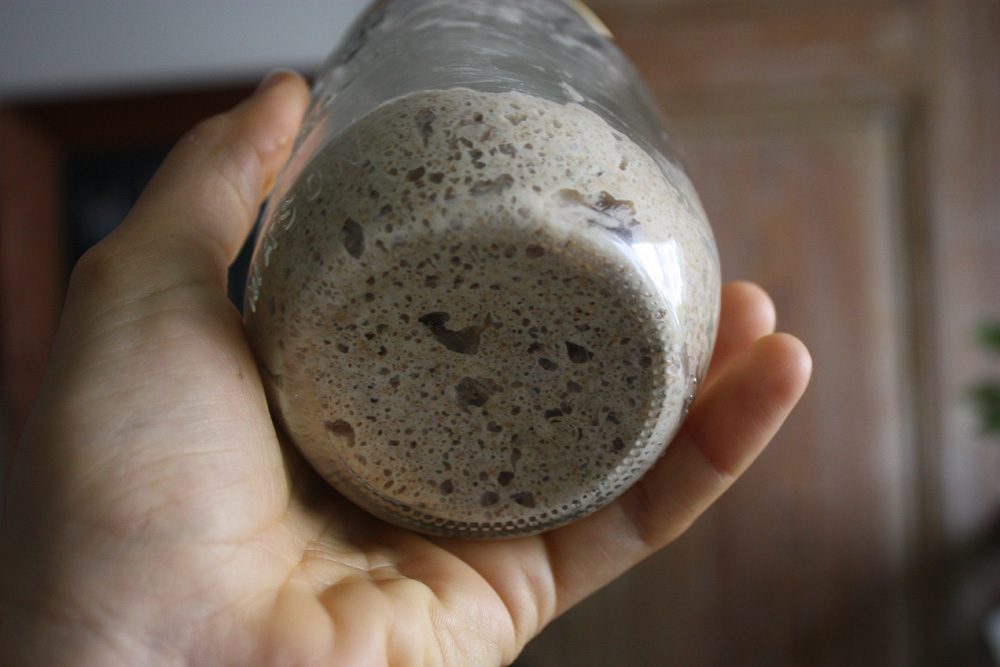
now listen up, because this is important, i want everyone to see that i do not get that dramatic rise and fall that we all talk about. it just sort of puffs up, not dramatic, right? ahhh, but if you notice when i flip the jar over to have a look-see in the bottom you will find evidence of some gorgeous fermentation. now that's impressive. and yes, throughout the day i flip over my little jar because it always makes me smile. little joys...

 1 hour after feeding

2 1/2 hours after feeding

6 hours after feeding

so, dear reader, if you think that a stiff starter will not ferment, i think the photos above prove otherwise, so forge on! not only will it ferment, but it will make fantastic bread...


onward.

listen, i know i'm no iconoclast when it comes to my bread, in fact, i think my baking may be a little mundane. i get on kicks, see, and i run with a certain flour because i'm digging it, and i'm not ready to forge ahead with another flour because i'm also thrifty. if i have 10 pounds of rye, you all are going to see a lot of rye. this is also why i don't post weekly (i think i do every 2 weeks at this point), because you all would end up seeing the same bread over and over again. i try only to post if i have something new to show you, or else, why bother. just know that i am over here baking regularly.


so, this classic uses spelt. not white or whole like i have been using, but this 'light' spelt that seems unique to bob's red mill. i've been futzing around with it lately, so you are going to see two variations in the upcoming weeks, this one today, and one more. i have some flour to use up before i move on to something new.


i began with a moderately hydrated dough. if i added too much water in the start, all of the olive oil and liquid from my additional ingredients would have pushed it over the hydration edge. it was pretty easy to work with, this dough, despite the hefty additions.  i have a habit of loading up my bread with goodies because what i don't like is some 'bready' thing that's distinctly separate from the inclusion of whatever it is that i add, in this case, leeks etcetera. my vision with this: you bite into it, see, and get a balanced mouthful of this chewy crust with a bit of bacon, cheese, and leek. which brings us to our...

verdict: this bread turned out to be AMAZING! full gelatinization and a shattery/brittle crust was realized, and i don't even have to tell you what the classic combination of leeks, bacon, and gruyere tastes like. i think you already know. but here's the thing, the crumb was so UBER TENDER that it pretty much melted in my mouth, and i am so glad that now i get to share this with all of you!

and without further blather, here are the fabulous details of our classic. please write and let me know how yours turned out for you!


THE EVENING BEFORE THE BAKE


make your levain:

40g 90.5%, 100% brm dark rye starter (you can use your 100% hydration starter for this)
80g brm dark rye flour
80g h2o


12 hour levain

mix together the above ingredients, and when fully amalgamated, allow it to ferment. mine fermented for 12 hours overnight. it does not have to ferment this long.

THE DAY BEFORE THE BAKE

when the levain has come to fruition, create the dough:

200g levain
250g brm light spelt flour
250g ka bread flour
325g h2o
260g leeks (weighed uncooked)
340g thick cut, applewood smoked bacon (weighed uncooked)
140g cave aged gruyere cheese (don't get the cheap stuff)
12g good fruity olive oil, plus an additional TB for the leeks (see below)
8g kosher salt (one reader asked if he could use fine sea salt... of course you can!)


ready for autolyse

combine the levain, flour and water until you reach a shaggy mass, allow it to autolyse for a full hour. while this bit of magic is taking place, prepare the following:

slice the bacon into flags and brown over medium heat. remove from heat. with a slotted spoon, remove bacon from pan and drain on paper towels. pop in the fridge to cool.


pour the bacon fat from the pan and deglaze with 1/2 cup of water, scraping up the browned bits on the bottom. slice the leeks into flags, rinse and add to the pan with 1 TB of olive oil. sweat these down till soft, then spread out on a plate and cool in the fridge.


cut the gruyere into cubes. set aside.

back to our dough. after autolyse, squish the salt and olive oil into the dough with your fingers until thoroughly amalgamated. the four-hour bulk fermentation begins.

for the first two hours of the bulk fermentation, perform a series of turns every half hour, and at the first turn add the bacon, cheese and leeks...


after the first turn, the ingredients thoroughly enrobed by the dough.

sort of fold the dough over the ingredients to envelop them, then turn the dough twice more. complete the remaining 3 series of turns over the next hour and a half, ensuring full dispersal of the ingredients, and pressing any escaping cubes of cheese or bits of bacon deeply into the dough with your finger.

after the two hours of turns, pop the dough into the fridge to finish its ferment for its final two hours. notice the picture below how i managed to keep all the goodies in the dough after the turns.


after turns, the goodies still hidden in the dough.

when the bulk fermentation is complete, turn the dough out onto a counter that has been dusted with organic brown rice flour and form into a loose round. allow the dough to rest for 15 minutes before shaping it into a boule.


after 4-hour bulk fermentation


dough, just turned out, dough just loosely shaped/tucked, dough resting

after it has rested 15 minutes, shape into a boule, then pop it into a linen lined bowl that has been dusted with rice flour. pop into the fridge and ferment for 17 hours.


rested dough with rainbow, shaped into a boule, ready for final fermentation in its linen-lined bowl

THE DAY OF THE BAKE

preheat the oven outfitted with a combo cooker and a baking stone to 550 degrees for a full hour. after this hour, unearth the dough onto a peel, being sure that a piece of parchment has been placed over the mouth of the bowl for easy sliding; score, then slide it into the shallow end of the combo cooker. for this bread, i chose a 'bulls-eye' score.

fully proofed, naked as a jaybird, bulls-eye scoring, into the combo it goes...

cover with the fat end, turn the oven down to 475 degrees and steam the loaf for 30 minutes. after 30 minutes of steam, remove the lid of the combo cooker and jump for joy because it's awesome (and so are you).

steamed

slide it back into the oven and turn it down to 450 degrees for 15 minutes, then rotate the pan and turn the oven down to 400 to finish baking, mine took another 15 minutes, for a total of one hour, and i did take the temp of this bread. it came out to 210 degrees. i generally do take the temp of bread that's stuffed with a lot of goodies, just to be sure it's fully baked. I know 400 degrees sounds low, but the cheese will brown the crust quickly, and that bread, as dense as it is with all of those humectant things that we added will need to bake for the full hour.


please wait at least 1 1/2 hours before slicing into this bread. it really needs time to rest so that it will completely stop baking (bread actually keeps baking for a bit when it's just pulled out of the oven), and the moisture has time to properly distribute throughout the bread. this will enhance the texture of the crumb. as well, when you slice it, a good way to store it so that that sliced end does not get hard is to store it cut side down on the counter. then, throughout the day you can take whacks from it without having to slice off a brittle bit from the cut end first. see the photo above.

to the staff of life!

THE SUPERFLUOUS SHOTS


this bread was classic enough to send over to wild yeast's yeast spotting for appraisal.


Translate

Follow My Other Blogs Too!

Popular Posts

Search This Blog

get a hold of me at

tartine-bread-experiment[at]live[dot]com

Followers

Except where noted otherwise, all content within the blog posts on this site, http://tartine-bread.blogspot.com/, are the sole intellectual property of Francis-Olive Hampton and protected under United States copyright laws: Copyright protection is available for all unpublished works regardless the nationality or domicile of the author. Copyright protection subsists from the time the work is created in fixed form. The copyright in the work of authorship immediately becomes the property of the author who created the work. Only the author or those deriving their rights through the author can rightfully claim copyright.

No part of any blog post shall be duplicated or manipulated for private use without prior consent.